Loading…


Article
Discover what the latest RBA cash rate decisions mean for your brokerage. Learn how to track borrowing capacity, lender rate pass-throughs, and client trigger points to turn market uncertainty into new business.

Every time the Reserve Bank of Australia makes a cash rate decision, the Australian mortgage market shifts. Borrower behaviour changes. Lender pricing moves. Client anxiety spikes. And the phone in your brokerage either rings more or goes quiet.
The RBA has hiked the cash rate three times in 2026, but chose to hold it steady at its most recent meeting. The cash rate target now sits at 4.35%, its highest level since late 2024.
For mortgage brokers, this is not just a macroeconomic story. It is a direct signal about what your clients are feeling, what lenders are doing, and where your next wave of business is coming from, if you are monitoring the right things.
This guide breaks down exactly what Australian mortgage brokers should be watching after every RBA decision and how to turn that monitoring into a competitive advantage for your firm.
Before diving into what to monitor, it is worth understanding the full picture of where the RBA stands right now.
The third rate increase in 2026 reflected continued concern from the RBA about persistent inflation and strong household spending, with inflation remaining above the target range of 2 to 3 per cent.
While inflation has fallen substantially since its peak in 2022, it picked up materially in the second half of 2025, with information since suggesting that some of the increase reflects greater capacity pressures.
Following the RBA's June meeting, the board explicitly said it will remain focused on its mandate to deliver price stability and full employment, and that it will do what it considers necessary to achieve that outcome, including increasing the cash rate target further if required.
The nation's big four banks are split on whether further cash rate rises will occur in 2026. Westpac economists had previously forecast a June rate hike but have since revised their timing, now expecting two further increases in August and September as second-round inflation effects from higher fuel and energy costs take hold. ANZ is not currently predicting any further moves in 2026, with its latest outlook forecasting two 25 basis point cuts in September and December of 2027, bringing the cash rate to 3.85% by year end.
The message for brokers is clear. Uncertainty is the defining feature of this rate environment. And uncertainty is exactly where expert brokers add the most value.
The most immediate and practical impact of any RBA rate decision for mortgage brokers is the effect on borrowing capacity.
Higher interest rates can reduce borrowing capacity because lenders assess a borrower's ability to meet repayments under higher-rate scenarios.
Canstar research shows a single rate hike can reduce an average income earner's borrowing capacity by around $12,000, with two hikes doubling that impact. For a borrower who was pre-approved six months ago, that reduction could be the difference between securing their target property and being priced out entirely.
After every RBA decision, brokers should:
This is not just good service. It is a direct revenue protection activity that keeps your pipeline moving regardless of what the RBA does next.
Not all lenders respond to RBA decisions in the same way, at the same time, or by the same amount. This is one of the most underutilised monitoring opportunities for mortgage brokers.
Lenders will decide if they change their rates and when they pass it on to their customers, but not all lenders move at the same pace.
In a previous rate movement, many banks chose to pass on higher home loan rates in just days, while Macquarie took a different approach, waiting over two weeks so customers had more time to adjust and plan their finances.
Rate tracking by Canstar shows 11 lenders, including ING, BOQ, Community First and Queensland Country Bank, have reduced at least one variable home loan rate since a recent cash rate increase, with the cuts appearing to reflect growing competition for new borrowers rather than a broader shift in lending conditions. After every RBA decision, brokers should:
Every RBA rate hike creates a new wave of refinancing demand. Borrowers who were comfortable with their repayments six months ago are now recalculating. And the ones who feel the most pressure are the ones most likely to act, if their broker reaches out first.
Changes to the cash rate flow through to household finances quickly, and when rates rise, loan repayments increase and borrowing becomes more expensive.
Mortgage holders will likely feel the impact quickly, as lenders typically pass on RBA rate increases to variable home loans, with a $600,000 mortgage potentially rising by approximately $90 to $100 per month depending on the loan term and interest rate. For households already dealing with rising living costs, even small increases can add up significantly over time.
After every RBA decision, brokers should segment their client database into three groups:
A personalised outreach to each group, rather than a generic email blast, is what converts rate anxiety into refinancing appointments.
The RBA does not make decisions in isolation. It responds to data. And the brokers who understand which data points drive RBA decisions are the ones who can anticipate market movements and position their clients ahead of the curve.
The RBA Board has stated it will be attentive to the data and the evolving assessment of the outlook and risks to guide its decisions, paying close attention to developments in the global economy and financial markets, trends in domestic demand and the outlook for inflation and the labour market.
The key indicators brokers should track between RBA meetings include:
You do not need to be an economist to monitor these indicators. A simple monthly review of ABS data releases and RBA communications will keep you informed enough to have credible, confident conversations with your clients about what is coming next.
The big four banks employ large economics teams whose rate forecasts directly influence how lenders price their products, how borrowers plan their finances, and how the media reports on the housing market. Monitoring these forecasts is a practical tool for brokers.
Here is where each major bank currently stands on the rate outlook:
NAB Chief Economist Sally Auld said: "We have greater conviction that the next move in rates is down, but less conviction on the timing."
What this means for brokers:
One of the most common questions brokers receive after every RBA decision is whether clients should fix their rate. The answer depends on the rate outlook and right now, that outlook is genuinely uncertain.
CBA economists see a prolonged hold through 2026, before forecasting two 25 basis point cuts in May and August of 2027, depending on economic outcomes and global developments. Upcoming economic data will be critical in shaping the outlook for monetary policy.
With Westpac forecasting further hikes and CBA and NAB forecasting a prolonged hold before eventual cuts in 2027, the fixed versus variable conversation requires careful, client-specific analysis rather than a one-size-fits-all recommendation.
Here is a simple framework brokers can use with every client considering fixing their rate:
The key message for clients is this. There is no universally right answer on fixing versus variable right now. The right answer depends entirely on their individual financial position, risk tolerance, and life plans. That is exactly why they need a broker.
RBA decisions not only affect borrowers. They directly influence property market activity, auction clearance rates, vendor behaviour, and housing supply conditions. Brokers who track these indicators stay connected to the broader context in which their clients are operating in.
Activity and prices in the housing market grew strongly over the past year, although housing price growth moderated somewhat at the start of 2026. Key property market indicators brokers should monitor include:
Brokers who stay connected to local property market conditions are better positioned to advise clients on timing their purchase or sale decisions, adding value that goes well beyond simply finding a competitive rate.
Beyond the economic data, brokers should monitor how RBA decisions are affecting borrower confidence and the way clients are approaching financial decisions.
Borrowers are continuing to reassess budgets, borrowing capacity and loan structures as interest rates remain elevated, with many taking a more cautious and measured approach while waiting for certainty around rates and the broader economy.
For homeowners, first home buyers and investors, the focus has shifted from when rates might fall to what higher rates mean for borrowing, property decisions and household budgets.
Brokers who understand this shift in borrower psychology can adapt their communication style and service offering accordingly:
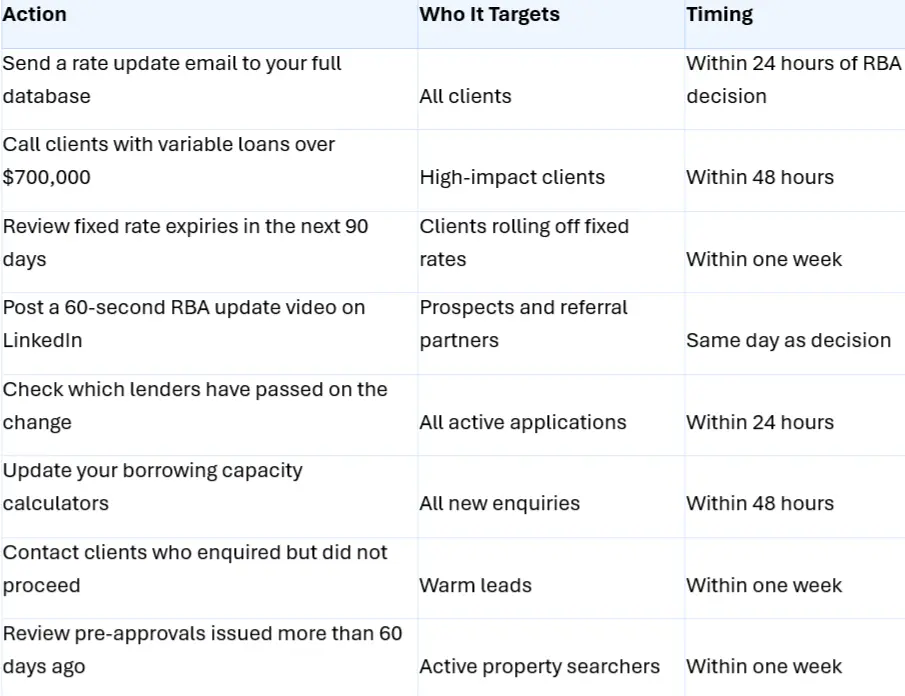
The rate environment is uncertain. Your clients are anxious. And the brokers who communicate proactively, monitor the right indicators, and position themselves as trusted guides will write more business in 2026 than at any point in the last decade.
Book a 10-Minute builureAI Demo
See how builureAI helps Australian mortgage broker firms automate post-RBA client outreach, track lender rate movements in real time, and build a business that grows regardless of what the RBA does next.
30-minute discovery call. No deck, no slides, just a real conversation about what you're trying to build and whether we can help.