Loading…

Article
Your CRM manages the pipeline, but your intake workflow sets the foundation. Discover how digital fact finds, ID verification and automated compliance workflows can help Australian mortgage brokers reduce manual work and improve file consistency.

Inshu Misra
Founder & Chief Executive Officer
Shifting from basic CRMs to automated fact finds, instant ID verification, and seamless compliance with the National Consumer Credit Protection Act 2009 (“the NCCP Act”) has become essential.
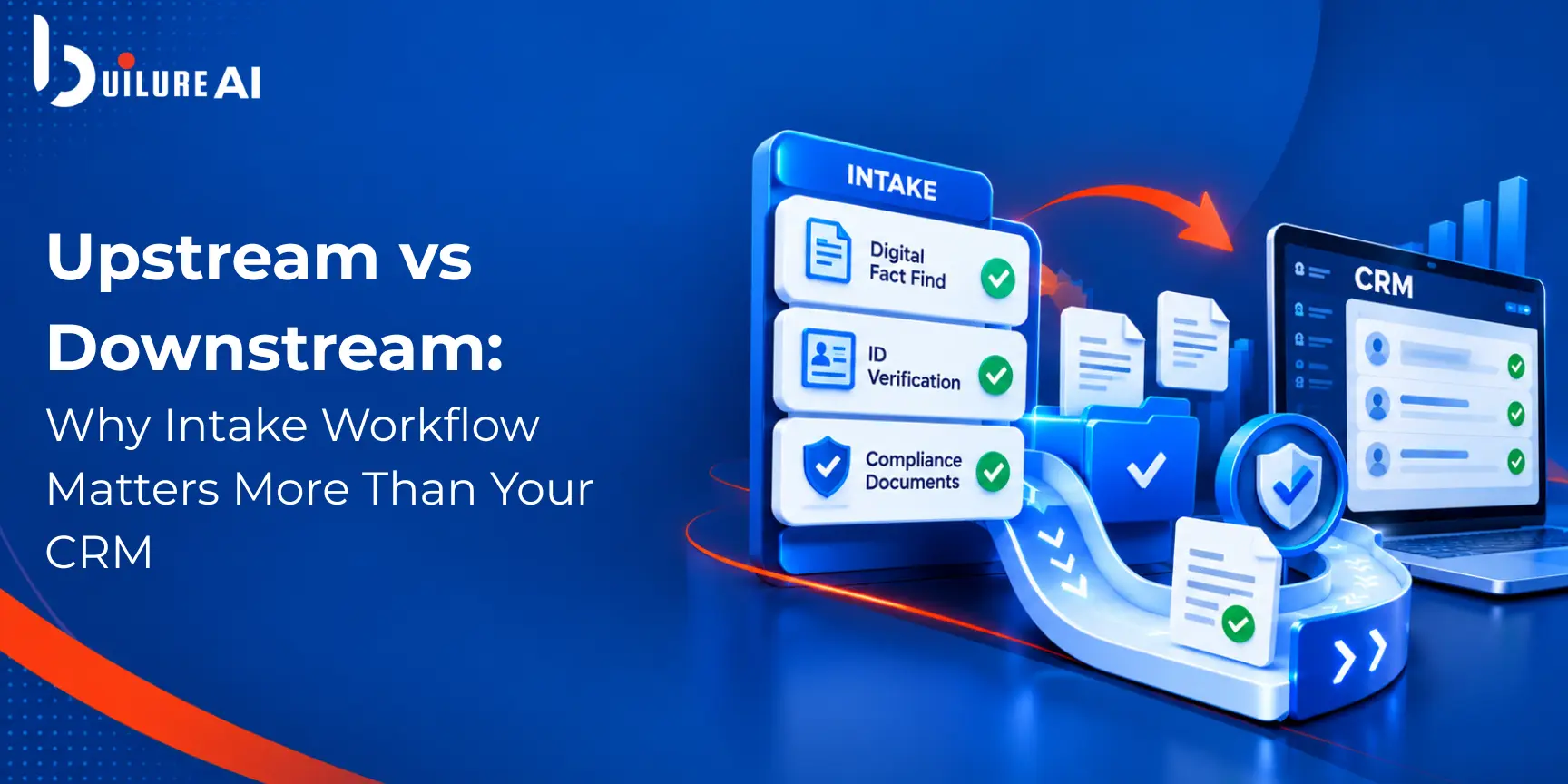
Most mortgage brokers – asked what they need to grow – usually land on CRM. Which platform? Have we migrated? Is our pipeline visible? These are downstream questions, focused on what’s already entered the business instead of what happens when new clients make contact.
Intake workflow is where deals are won or lost, where risk is created or eliminated, and where client experience is shaped. The CRM is a filing cabinet; the intake is the front door, and the doors of many brokerages are faulty.
Upstream vs Downstream
Downstream thinking is reactive: how do I manage, track, and report on loans already in my pipeline?
Upstream thinking is proactive: how do I capture the right information the first time, verify identity quickly and accurately, and build compliance from the first touchpoint? Here, most brokerages have gaps – gaps which compound over time.
“Drowning in paperwork” is real, with brokers juggling fact finds, lender liaisons, and huge volumes of documents. Most of this burden is created upstream, in the intake phase, filtering downstream through the entire file. Fixing intake eliminates significant downstream chaos.
The Fact Find is Your First Compliance Document
The fact find isn’t just a data collection exercise, but the foundation of responsible lending assessments and the bulwark of defence in compliance audits.
ASIC oversight, Responsible Lending obligations, Best Interests Duty requirements and aggregator audit standards make error margins thin. When client needs and objectives are improperly captured at intake, these margins are quickly breached.
A suitable product recommendation is impossible if the client's situation was never understood in the first place.
ASIC’s Responsible Lending Guide describes a four-step approach, starting with inquiry: asking open, specific questions about the customer's situation covering income, employment, living expenses, existing debts, dependents, and short and long-term goals.
A manual fact find, by telephone or over email, makes it difficult to demonstrate that this standard was met across every file. An automated digital fact find changes this. For brokers using a structured online intake form, every question is asked identically. Responses are timestamped and directly linked to files. There is no ambiguity about the questions or answers. This also creates an audit trail.
ID Verification Cannot Be an Afterthought
Verifying identity by reviewing physical documents is time-consuming, lengthens mortgage application processes, and introduces potential inaccuracy due to human error. Further, reliance on physical documents invites fraud, forged documents and false identities. Brokers handle sensitive personal information, such as tax returns and Medicare cards. Verification of identity under the NCCP and AML/CTF frameworks is mandatory.
Tools to do this properly are readily available. ID verification services provide reliable verification solutions crucial to modern mortgage broking. These services adhere to rigorous regulatory standards, and enable users to verify their identity digitally without need for in-person visits.
The shift toward digital ID is also being driven legislatively. From November 2026, private sector entities will become eligible to participate in the Australian Government Digital ID System. Brokers who have already embedded digital VOI in their intake workflow will draw further ahead of competitors who haven’t.
NCCP Compliance Starts at “Hello”
The NCCP Act is designed to protect consumers and uphold ethical and professional standards in the finance industry. Lenders and mortgage brokers must hold an Australian Credit Licence (ACL) or be registered as authorised credit representatives, and must adhere to regulations set out in the Act.
This means compliance must be built from the first client interaction. NCCP compliance processes enable brokers to create the Credit Guide, Preliminary Credit Assessment, Product Comparison Reports and Credit Proposals, with documents auto-recorded and maintained to provide a backup and audit trail. When these processes are embedded into intake workflows instead of handled manually at lodgement, the risk of gaps drops dramatically.
ASIC and Best Interests Duty require clear file notes proving why a loan recommendation was appropriate. Poor documentation can lead to audit issues, remediation, and reputational damage. Often, brokers who get caught out have given sound advice, but cannot prove it because intake processes were defective.
The CRM is not the problem. A CRM helps manage relationships, track settlements, and stays on top of your trail book, but many brokers invest heavily in CRM configuration while running manual intake processes on emails and attachments. Manual workflows can introduce failure points including transcription errors when data is copied into a CRM, inconsistent file naming conventions, or missed documents. Every error must be corrected downstream, costing time, creating risk, and frustrating clients.
Integrating AI and automation ensures brokers can meet Best Interests Duty obligations while simultaneously achieving scale. Brokers growing volume without growing headcount are those who have automated the intake: digital fact finds that directly populate CRMs, instant ID verification without face-to-face meetings, and compliance documents generated automatically.
What a Modern Intake Workflow Actually Looks Like
For brokers building this properly, the sequence might be:
Preparing a mortgage pre-qualification assessment does not have to be time-consuming, with tools available to aggregate information to assess an applicant's suitability on one dashboard.
The Bottom Line
Your CRM won’t save you in a compliance audit, but your intake workflow might. The upstream process – the fact find, ID check, the needs and objectives capture – is key. Get it right, and downstream becomes faster and cleaner.
Ready to Upgrade Your Intake Workflow?
builureAI is built for Australian mortgage brokers, with tools to automate digital fact finds, streamline compliance, and meet NCCP obligations. Book your builure AI demo today and see how brokers across Australia are working smarter, settling more loans with less friction. Reach out at sales@builure.com.au to get started.
30-minute discovery call. No deck, no slides, just a real conversation about what you're trying to build and whether we can help.